|
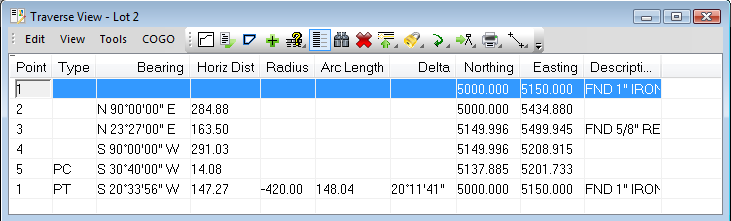
Traverses are defined by the sequence of points. TPC displays a traverse's point sequence in the Traverse View stating with the first traverse point at the top.
In TPC, many program functions that depend on a traverse's point sequence. So two traverses with the same 10 points in different sequences for example, are not the same traverse.
In the example shown here, the point sequence closes back on itself by repeating point '1' at the end. Also, the last two points define a curve as designated by the 'PC' and 'PT' point types.
If the Type column is blank, that point is a control point.
Computations
Traverse computations are based on the traverse point sequence. Changing the sequence may change the computed positions of the points.
Sharing Data
Many import types create their own traverses to replicate the sequence of the imported points.
LandXML parcels and alignments are good examples of the importance of maintaining point sequences. When TPC both imports and exports LandXML files, parcels and alignments transfer perfectly.
Drawings
A traverse is represented in a drawing based on its point sequence. Changing the sequence may change the shape of the traverse in the drawing.
Breaklines
A surface creates breaklines from a traverse based its point sequence. Changing the sequence may change the breaklines.
Legal Descriptions
TPC's Phrase Driven Legal Descriptions use the traverse point sequence to create the individual courses being described and their relationship (tangent, cusp, etc.).
Related Topics
Traverses
|

